


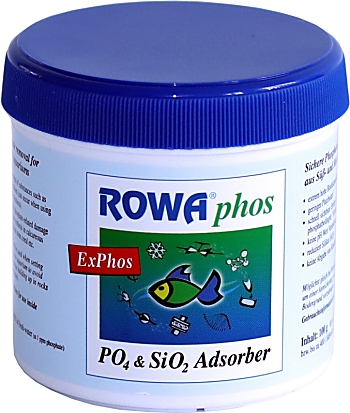
Overview
Phosphate enters the aquarium primarily through fish food, waste, and the decomposition of organic matter. Rising concentrations not only promote algae growth but can also impair the calcification of stony corals and calcareous red algae in saltwater aquariums. ROWAphos lowers the phosphate content to a near-natural level without altering the pH of the aquarium water.
The adsorbent material has an exceptionally high binding capacity and therefore requires very little space in the filter. In addition to phosphate, it also binds silicate, which can particularly promote the growth of diatoms. ROWAphos contains no previously used or recycled raw materials and is manufactured from chemically pure starting materials. When used properly, it does not release any bound pollutants into the aquarium water. Since the material is not aluminum oxide-based, the release of aluminumwhich can occur with similar adsorbentsis also ruled out.
Due to the manufacturing process, ROWAphos is delivered in a moist state. This moisture is not a quality defect but an integral part of the material. The water of crystallization it contains ensures that the pore structure is immediately and completely wetted, allowing the adsorbent to begin binding phosphate particularly quickly.
ROWAphos
- Highly effective removal of phosphate in freshwater and saltwater
- Also binds silicate
- Exceptionally high binding capacity
- Rapid adsorption effect
- Takes up little space in the filter
- No change in pH
- No release of aluminum
- High-purity, unused raw material
- Helps prevent phosphate-induced algae growth
- Protects the calcification of stony corals and calcareous red algae
- Suitable for new and existing aquariums
Application of ROWAphos
ROWAphos can be used in a separate, slow-flow phosphate filter or in the main filter. In the main filter, the material should be placed as the final filtration stage after biological and mechanical filtration. The adsorbent material is placed in a suitable fine-mesh filter bag or inserted between two layers of fine filter wool. The water must be able to flow evenly through the material. Excessive flow or vigorous turbulence of the granules should be avoided.
For newly set up aquariums, it is recommended to use ROWAphos from the very beginning. This prevents large amounts of phosphate from accumulating in the substrate and decorations. In aquariums that have been running for some time, in addition to the phosphate measurable in the water, a significant amount may also be bound in rocks, substrate, and other materials. If initial phosphate levels are high, you should therefore initially calculate using a correspondingly smaller volume of water per package or an adjusted amount of material.
Coverage for normal maintenance use:
100 g for up to 800 liters of freshwater or 400 liters of saltwater
250 g for up to 2,000 liters of freshwater or 1,000 liters of saltwater
500 g for up to 4,000 liters of freshwater or 2,000 liters of saltwater
1, 000 g for up to 8,000 liters of freshwater or 4,000 liters of saltwater
5,000 g for up to 40,000 liters of freshwater or 20,000 liters of saltwater
The actual coverage and service life depend on the existing phosphate content, the amount of food introduced, and the amount of phosphate stored in the substrate or decorations. In heavily loaded aquariums, a higher dosage or more frequent replacement may therefore be necessary at first. The phosphate level should be checked regularly using a reliable test kit. If the value rises again, the materials absorption capacity has been exhausted and ROWAphos must be completely replaced. Regeneration of the used adsorbent is not intended.
 Manual ROWAphos -highly effective phosphate and silicate adsorbent
ROWA Aquaristik GmbH
ROWA Aquaristik GmbH
Heinrich-Hasemeier-Straße 33
D-49076 Osnabrück
info@rowa-wasser.de